
The dance
What is Zapin?
Zapin is a Malay dance with Arab roots, loved across Malaysia and most closely linked with Johor.
It came to the Malay world with Arab traders and scholars from Hadhramaut, in Yemen. Its name is said to come from the Arabic zafn, “movement of the feet”. Over the centuries, Malay communities made it their own.
Zapin was once danced by men only, often at weddings and festivals. Today men and women dance it on stage, in schools and at cultural shows.
A Zapin performance has three parts
- 01
Taksim
Opening solo on the gambus (Malay lute). The dancers enter and greet the audience.
- 02
Ragam & Kopak
The main body: ragam are the step variations; kopak are the loud interludes on the marwas hand drums between them.
- 03
Wainab
The closing section that ends the dance; some teachers call it tahto or tahtim.
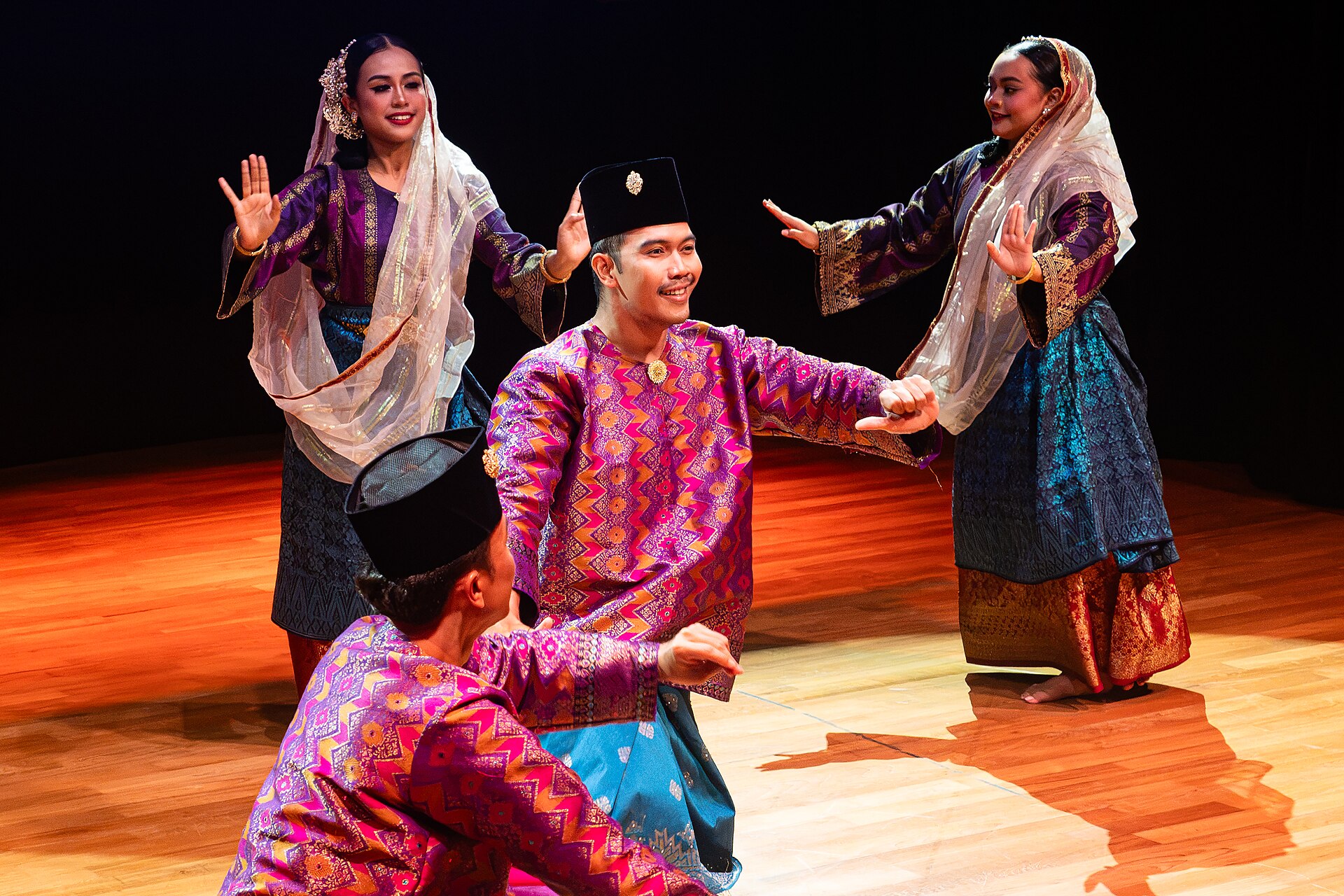
Zapin at a glance
Music
Gambus (Malay lute) and marwas hand drums, often with violin and accordion.
Rhythm
Counted in 8s: three steps and an accent, done twice.
Style
Small steps, feet kept low, knees soft and hips still.
Where
Johor, and across Malaysia, Brunei, Singapore and Riau in Indonesia, each with its own style.
Learn Zapin with ZapinVerse
Practise each step in VR, get a score for every move, and let your teacher see how you feel.